Impact Highlight: New Hampshire’s Division for Children, Youth, and Families (DCYF) developed and procured for a new community-based voluntary services program, which offered families access to resources that leaders hoped would help prevent future child welfare involvement. By adjusting intake strategies, including increasing in-person meetings, service providers went from enrolling 45% of referred families to 70%.
Project Context:
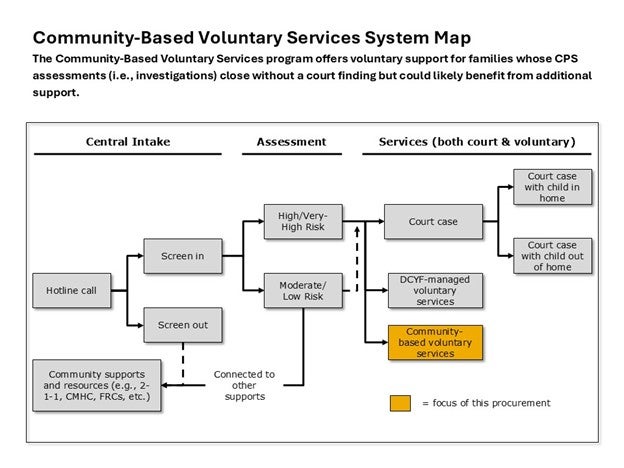
The GPL was supporting New Hampshire DCYF as they improved their service array to better serve children and families. As part of these efforts, leaders wanted to reach families who were being investigated by child protective services (CPS) but did not have an open case. The goal was to offer these families stabilization services that might prevent future CPS involvement.
In 2017, among all New Hampshire families investigated by child protective services for abuse or neglect, 32% were reinvestigated within 12 months and 40% were reinvestigated within 18 months.
DCYF knew these families could benefit from stabilization support, but staff were limited in what they could provide without an open child welfare case and because existing community-based resources were either insufficient or full.
DCYF decided to procure a program for this population: Community-Based Voluntary Services (CBVS).
CPS workers would offer to connect families without a case to CBVS providers who could offer crisis-mitigation support, help navigating additional resources, and some DCYF-funded services.
Families could decide whether they wanted to participate. Their decision would have no impact on future CPS decisions if they were ever reported again to the hotline.
CBVS providers would report aggregate engagement and outcome data to DCYF to guide program performance improvement, but no individual client data could be shared without a family’s consent.
Helped DCYF design the CBVS program. This involved:
Analyzing DCYF data to identify population characteristics and top needs of families in the CBVS target population — families with investigations closing, but who faced increased likelihood of future child welfare involvement.
Incorporating input from the previous request for information (RFI) to define key elements of the program. This input included centering family engagement, allowing for telehealth and other creative approaches to ensure statewide access, and covering startup costs to support providers in launching new, high-quality programs.
Building referral protocols to ensure that families who needed supports could get connected to CBVS programs.
Developing a guide for staff that summarizes eligibility requirements and referral processes. This helped staff prioritize families for limited slots in certain programs and make earlier referrals to services.
Helped DCYF identify ways to improve the program. This included:
Conducting focus groups with families enrolled in the services to seek their feedback.
Families suggested that while they were happy with the support, they thought DCYF could strengthen the initial referral to the program, including by improving the program pitch from DCYF staff.
Creating a community of practice among the CBVS providers so they could learn from each other and share insights from their data-driven performance management practices.
Results:
More potential providers applied. NH received among the highest number of bids in the state’s history in response to the CBVS request for proposal (RFP).
The bids were driven, in part, by innovative procurement strategies including significant opportunities for community input, vendor conferences, an RFP cover letter from agency leadership clearly articulating the vision for CBVS used in extensive community outreach, and the opportunity for providers to submit a comprehensive budget inclusive of indirect costs.
Once the program was up and running, a high number of families enrolled in voluntary services. Officials learned that families were more likely to enroll in services if a community staff member met with them in person soon after a referral. After streamlining intake and hiring employees with lived experience, the number of in-person meetings with families increased, which meant service providers enrolled 70% of families referred to them, an increase from 45%.
Case management could serve more families. For the first time, DCYF offered state-wide case management to a previously underserved population. Many of these families had been dealing with significant challenges yet had not been offered services.
Families’ voices were reflected in program design. DCYF decided to design the program as both voluntary and based in the community, rather than being based in the state’s child welfare system. This decision was in response to feedback from parents and other community members who indicated this would decrease stigma and make the program more accessible.
DCYF dedicated funding to help families overcome barriers to engagement. DCYF required that providers offer families flexible funding to address barriers that could prevent a family from participating in CBVS (e.g., car breaking down, a need for pest fumigation, or other concrete needs).
Families are more likely to engage long term if we’re meeting with them in 72 hours. Most importantly, families feel like they’re a priority. They feel important when I’m making an effort to reach out.Tina Holmes
Family Engagement Liaison, The Family Resource Center of Northern New Hampshire
1 / 3
We want to serve the right family at the right time, so that’s why community-based voluntary services was created. A key difference is this is a voluntary service. You don’t have the court or the child welfare service already involved, so we have to meet the family where they are. We really want to serve the families preventatively in the least intrusive way possible and meet their concrete needs, meet their crisis needs, and meet their mental health needs.Michael Donati
Bureau Chief; Community, Family and Program Support, New Hampshire Division for Children, Youth and Families
2 / 3
What we’ve seen is that face-to-face meeting is so pivotal, in terms of that family staying engaged. Even more so than the timing, the sheer act of a face-to-face contact with a family, meeting with them at a local coffee shop, at a place that’s comfortable for them has been such a huge indicator of success. It’s that ‘whatever-it-takes’ mentality to serve that family at the right point in the least intrusive way.Michael Donati
Bureau Chief; Community, Family and Program Support, New Hampshire Division for Children, Youth and Families