
Improving Government Performance and Responding to AI-Driven Workforce Changes: Takeaways from Convening of State Government Leaders
Cambridge, Massachusetts

Can government deliver the results that residents expect? Are they doing so in the most efficient way possible? At the state level, how can state governments turn governors’ priorities into reality?
States are creating new leadership roles focused on improving performance, coordinating across agencies, and delivering results for residents. But because these roles are relatively new and look different across states, leaders rarely have the chance to compare notes with peers doing similar work in other states.
In September 2026, the Government Performance Lab (GPL) brought together 36 state performance and workforce leaders from 15 states for a two-day convening at the Harvard Kennedy School. Attendees included chief performance and transformation officers, Governor’s Office operations leaders, and workforce commissioners and agency directors. Leaders shared strategies for turning executive priorities into action and strengthening state governments’ ability to deliver, and discussed how states are preparing for AI-related change in the workforce.
The convening featured speakers including Maryland Department of Labor Secretary Portia Wu, HKS Emma Bloomberg Lecturer Kimberlyn Leary, The Project on Workforce at Harvard (HPoW) Executive Director Kerry McKittrick, HBS Faculty and HPoW Co-Director Joseph Fuller, Scott Kleiman of RAISE US, GPL Executive Director Gloria Gong, and GPL Faculty Director Jeffrey Liebman. The convening was hosted by the GPL, housed at the Taubman Center for State and Local Government at the Harvard Kennedy School, in collaboration with The Project on Workforce at Harvard.
Defining state performance roles and offices
State performance offices are relatively new additions to the machinery of state government, and no two offices look exactly the same. Some offices report directly to the governor, while others sit in a budget office or as part of a cabinet secretary’s portfolio. Some focus on a handful of gubernatorial priorities, while others build performance systems intended to serve agencies across government. The performance offices represented at convening ranged from 3 to 50 staff.
Participants compared their offices’ structures, authority, staffing, and core activities. variations in their set-ups, including their statutory authority, whether executive orders had been used to found them, their staffing and reporting structures, how many agencies directly report to them, and what their budget set-up was. They also discussed differences in their roles and areas of focus such as performance accountability, continuous improvement, or results acceleration for specific projects. For example, some states are leveraging performance management to reduce SNAP error rates, implement corrections reforms, reducing DMV wait times, and improving unemployment insurance call center performance. Others are trying to build performance management capacity of other government agencies through efforts such as offering training programs, organizing cross-functional peer groups, and creating recognition programs for performance improvements.
The variation across offices and relative newness of performance roles in state governments are exactly why this convening was valuable. Leaders noted that there’s no professional association or established playbook for performance roles, making this convening a useful and unique opportunity for collaboration and comparison.
Opportunity for Peer Learning and Knowledge-Sharing
Performance leaders emphasized the importance of peer-to-peer knowledge sharing and cross-state collaboration to achieve common goals. Many performance leaders were running new offices and talked to their peers about how to structure their office, hire new staff, and set strategic priorities. Performance leaders also discussed shared challenges they face in their work, including developing or consolidating performance metrics across different sources, breaking down silos across various agencies, and modernizing legacy systems to improve service delivery. States also expressed that it was valuable to learn from each other and share strategies related to implementing H.R.1. The convening was the beginning of a longer-term effort to keep state leaders connected and create more opportunities for them to learn from each other over time.
“We definitely walked away feeling energized about new ideas we can bring to Massachusetts,” said Massachusetts Chief of Strategy and Operations Adit Basheer. “It was incredibly helpful to meet fellow folks in the space who are tackling many of the same areas of focus.”
AI is reshaping state workforce strategy
The second day focused on how states are responding to AI-driven workforce change, including how to support workers in fields with high potential AI exposure and how to leverage data in new ways to better understand and respond to this change.
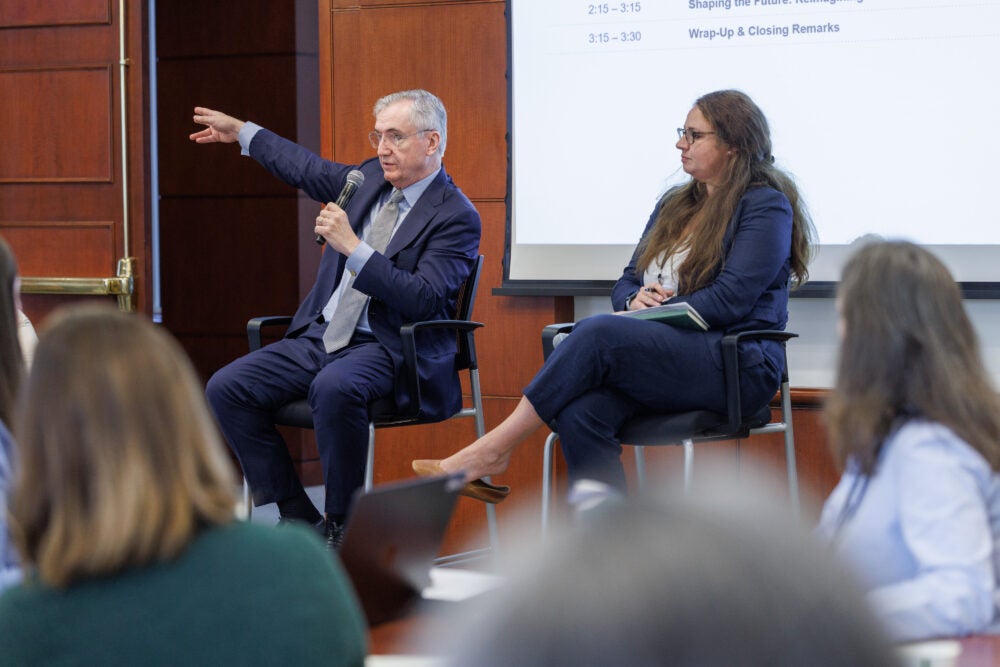
Joseph Fuller, HBS Faculty and Co-Director of The Project on Workforce at Harvard, and HPoW Executive Director Kerry McKittrick spoke about what is known so far about AI’s effects on the workforce. Professor Fuller encouraged state leaders to pay attention to how entry-level job descriptions are changing and stay in close conversation with major employers. He also noted that state governments are often one of the largest employers in a state and positioned to be a model for using AI in pro-worker ways. He also cautioned states of the risks of being hyper-focused on AI that they overlook change happening in automation.
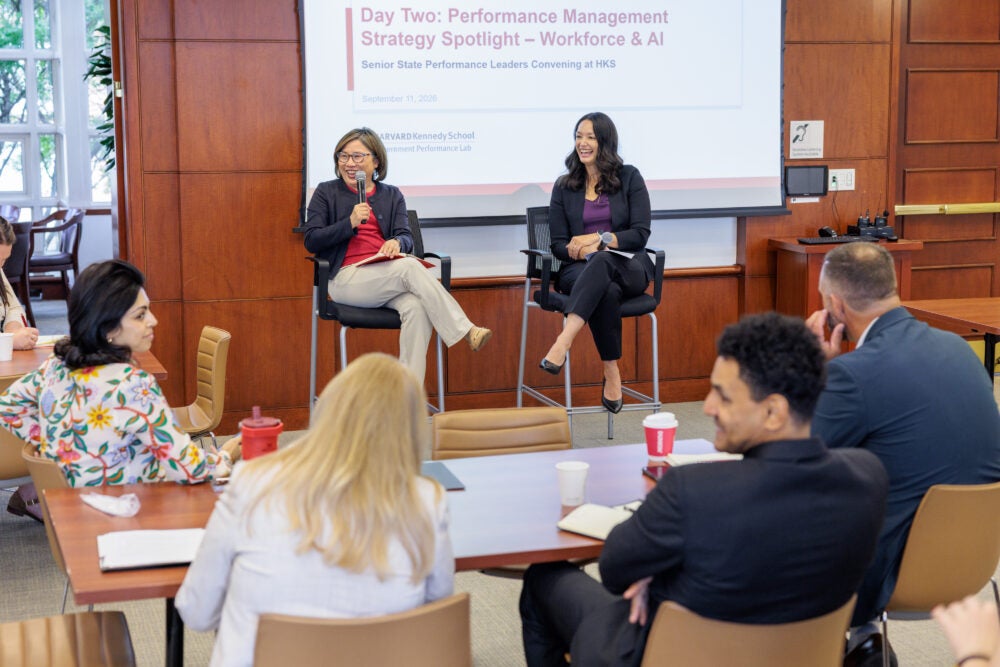
In a conversation with GPL Executive Director Gloria Gong, Maryland Secretary of Labor Portia Wu described the urgency for Maryland to respond to AI-driven change in a state that ranks among the top five in both AI adoption and workforce exposure. The state has launched new training programs for early- and mid-career workers as well as supports for small businesses to adopt new AI tools. Secretary Wu also stressed that technology can be an important part of the solution for the public sector to navigate these challenges, but also needs to be paired with strong operations and staff capacity to effectively implement and adopt new technologies.
The convening was a chance for state performance and workforce leaders to connect with a community of their peers and discuss common goals and challenges in their work. The convening is the beginning of a continued effort to bring these leaders together for collaboration and knowledge-sharing.