
Landscape Analysis of Nine Community Responder Teams
This material is based on work supported by Blue Meridian Partners through a grant to New York University. Any opinions, findings, and conclusions are those of the author(s) and do not necessarily reflect the views of Blue Meridian Partners or New York University.
Project Findings
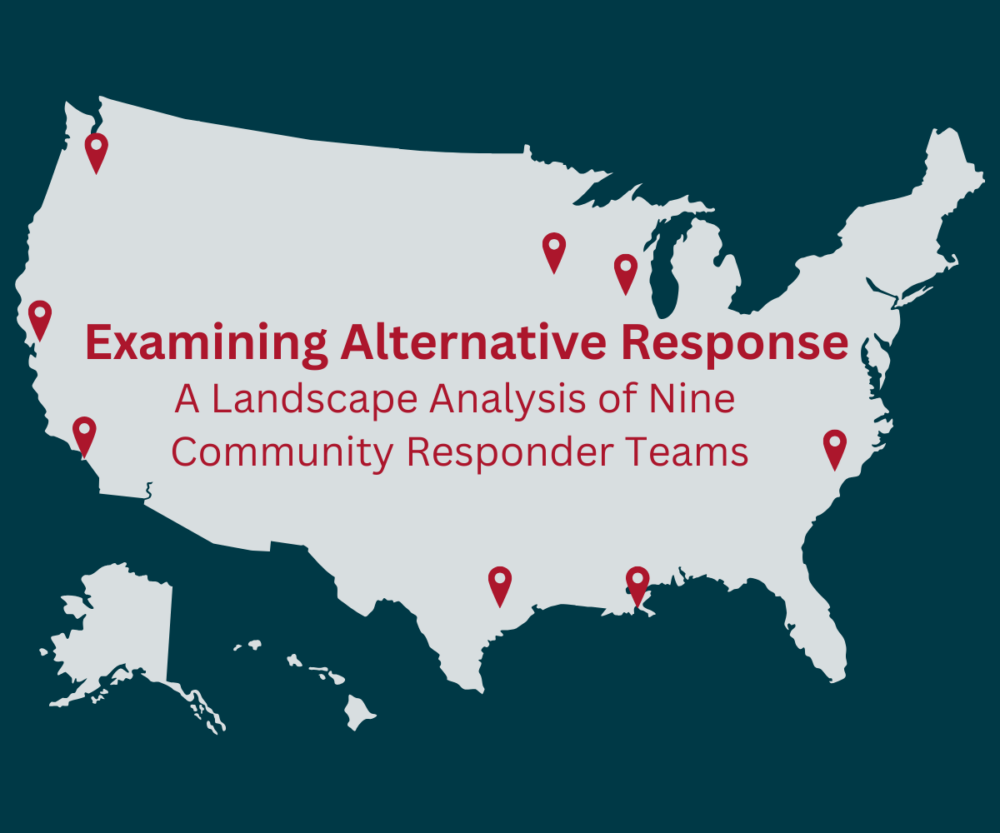
In 2025, the GPL conducted a landscape analysis of nine community responder teams (CRTs) using their 2024 program data to answer five, field-level questions: 1
- What do we know about where and in what contexts CRTs are currently operating?
- What variation exists in how CRTs are structured and deployed?
- What role do CRTs play in the emergency services system and in relation to other first responder teams?
- What indication do we have that CRTs are responding to 911 incidents as expected?
- What happens once CRTs respond to a 911 incident?
Using the results of this study, the GPL developed a centralized account of emerging trends in CRTs to support replication, scale, and additional research on CRTs and their impact on government systems and the people they serve.
Emerging Trends in Program Model Variation
CRTs are:
- Managed based on local agency and contracted provider capacity and expertise.
- Staffed using interdisciplinary teams of unarmed professionals with backgrounds in mental health, behavioral health, crisis care, and medical care, as well as people with lived experience.
- Growing to operate multiple teams seven days a week, with plans to iterate and expand program hours.
- Designed to respond to a range of non-violent 911 incidents beyond mental and behavioral health, including trespassing, welfare checks, and addressing social service needs.
Early Insights into CRT Performance
The majority of CRTs:
- Respond to incidents that come directly from 911 dispatch.
- Respond to calls alone, without additional responder teams on scene.
- Respond to incidents that fall into one of five common call categories, with mental health and welfare checks comprising the largest percentage of incidents.
- Respond to, and resolve, 95 percent of incidents on scene, when dispatched to 911 incidents as primary response.
- Provide immediate on-scene response, when dispatched to 911 incidents.
- Rarely request backup while resolving 911 incidents as a primary response.
- Provide connections to voluntary services including case management and care coordination, shelter/housing resources, and medical services.
Project Context
- Jurisdictions across the country are incorporating innovative approaches to respond to quality of life, mental health, and behavioral health-related 911 incidents.
- These approaches often include sending teams of unarmed, trained professionals to respond, commonly called Community Responder Teams (CRTs).2
- Publicly available information about the characteristics of CRTs is often limited to individual case studies listed across technical assistance provider websites, news articles, and jurisdiction-specific data dashboards.
- This lack of centralized, comparative program analysis limits the field’s ability to track and support new developments in CRTs, while placing the burden on local governments to conduct individual research about program models amid public calls for swift, effective program development.
1 This analysis is based on a small and non-representative sample of jurisdictions that are currently operating community responder teams (CRTs) nationally. The GPL selected programs included in this landscape analysis based on current or past participation in the GPL’s implementation cohort and that met the following criteria: 1) CRT program in operation for a minimum of ten months; 2) CRTs respond to a minimum of 100 incidents per month; and 3) programs must have the capacity to collect and share CRT and 911 data with the GPL based on active technical assistance agreements. Ten programs met the maturity, size, and data quality criteria. Of those, the GPL included nine programs that were able to share data.
2 Approximately half of the 50 largest U.S. cities have already launched or piloted community responder teams as part of alternative response programs. At the federal level, policies mandating the rollout of the 988 behavioral crisis line and investments in crisis intervention have encouraged local innovation on alternative response.